

Your kitchen already holds one of the most powerful skincare ingredients in the world.
Desi ghee has been used on skin in Pakistan and across South Asia for over 5,000 years. Ancient healers used it. Mothers passed the practice on to their daughters. Today, dermatologists and nutritionists are reconfirming what our grandmothers already knew.
But most blogs only scratch the surface. They list “moisturises skin” and move on.
This guide goes deeper. You will learn why each benefit works — the actual nutrients behind it — and how to use pure desi ghee in Pakistan the right way for your specific skin type.
Why Desi Ghee Is a Skincare Superfood
Desi ghee is not just cooking fat. It is a complex, nutrient-dense substance with a proven record in both traditional and modern skincare. Organic desi ghee in Pakistan is particularly valued because it comes from indigenous cow breeds raised on natural feed — and their milk produces ghee with a richer, more complete nutrient profile.
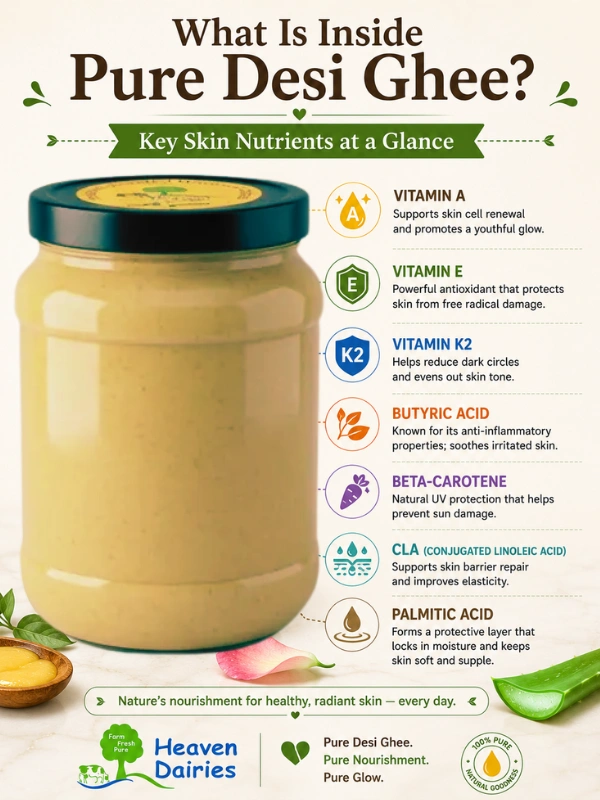
Here is the core nutrient stack that makes desi ghee work on skin:
| Nutrient | Type | Key Skin Function |
|---|---|---|
| Vitamin A (Retinol) | Fat-soluble vitamin | Cell renewal, collagen production |
| Vitamin E (Tocopherol) | Antioxidant vitamin | Free radical protection, hydration |
| Vitamin K2 | Fat-soluble vitamin | Dark circle reduction, skin tone evening |
| Butyric Acid | Short-chain fatty acid | Anti-inflammatory, barrier repair |
| Beta-Carotene | Antioxidant pigment | UV protection, skin brightening |
| CLA (Conjugated Linoleic Acid) | Fatty acid | Skin barrier strengthening |
| Palmitic Acid | Saturated fatty acid | Moisture retention, emollient |
| Omega-3 & Omega-6 | Polyunsaturated fats | Scalp health, skin cell repair |
No single synthetic cream contains this full combination in natural form. This is the foundation of every benefit listed below.
Benefit 1: Deep Skin Hydration That Lasts
Chemical moisturisers sit on the skin’s surface. Desi ghee penetrates it.
The fatty acids in ghee — especially palmitic acid and oleic acid — match the natural lipid structure of human skin. This compatibility allows ghee to move past the outer skin layer and reach the dermis. Once inside, it seals moisture from escaping. Skin stays soft for hours, not just minutes after application.
Vitamin E in desi ghee functions as both a humectant (attracts water to skin) and an emollient (holds it there). This dual action makes desi ghee in Lahore an exceptional choice for dry winter skin, which is a common complaint in Pakistan’s cold season from November to February.
How to use: Warm a small amount of pure desi ghee between your palms. Apply a thin layer on clean, slightly damp skin before bed. Focus on dry areas — elbows, knees, and cheeks.
Benefit 2: Natural Anti-Ageing and Wrinkle Reduction
Ageing skin has two enemies: free radicals and collagen loss. Desi ghee fights both.
Vitamins A and E in desi ghee are potent antioxidants. They neutralise free radicals — unstable molecules generated by sun exposure, pollution, and processed food — that break down collagen fibres. Collagen is the protein that keeps skin firm and elastic.
Vitamin A in particular stimulates collagen synthesis at the cellular level. It promotes skin cell turnover, which means older, dull cells are replaced by fresh ones faster. Skin appears firmer, smoother, and more even. This is the same mechanism behind synthetic retinol creams — except that in pure desi ghee, the retinol is naturally occurring and combined with skin-compatible fatty acids that reduce irritation.
Beta-carotene in grass-fed cow ghee adds another layer of protection. It shields skin from UV-induced photo-damage — a major cause of premature ageing, especially under Pakistan’s intense sun.
How to use: Apply a tiny amount of ghee to clean skin around the eyes and forehead at night. Use consistently for 4–6 weeks before evaluating results.
Benefit 3: Reduces Dark Circles Under the Eyes
The under-eye area has the thinnest skin on the entire face. It is prone to dehydration, inflammation, and pigmentation — all three of which create dark circles.
Vitamin K2 in desi ghee helps regulate blood vessel integrity. Poor circulation under the eye causes blood to pool, which shows through thin skin as darkness. Vitamin K2 supports the micro-vessels, reducing that pooling effect over time.
Vitamin E adds hydration to the under-eye area, plumping the skin so shadowing is reduced. Regular overnight application of a tiny amount of pure desi ghee in Pakistan on the under-eye area has been a traditional remedy for generations across Punjab and Sindh.
How to use: Use your ring finger (lightest pressure) to gently dab one small drop of ghee under each eye before sleep. Do not rub — only tap gently.
Benefit 4: Heals Chapped Lips Naturally
Cracked, dry lips are a universal problem in Pakistan — especially in winter and during Ramadan fasting periods.
Desi ghee is an immediate fix. Its fat content is occlusive, meaning it creates a physical barrier over cracked lip tissue and prevents further moisture loss. Butyric acid in ghee also reduces inflammation in damaged skin tissue, speeding up the healing process.
Unlike petroleum-based lip balms that only coat the surface, organic desi ghee in Pakistan penetrates the lip tissue and actually nourishes it. There are no synthetic chemicals, fragrances, or preservatives to worry about.
How to use: Apply a small amount of pure desi ghee to lips at bedtime. For a lip scrub, mix ghee with one pinch of raw sugar and one drop of honey. Gently rub on lips for 30 seconds and rinse.
Benefit 5: Soothes Eczema, Psoriasis, and Sensitive Skin
Inflammatory skin conditions, eczema, psoriasis, contact dermatitis — affect a significant number of people in Pakistan. Most commercial creams contain steroids or synthetic preservatives that cause dependency or side effects over time.
Butyric acid in desi ghee is a natural anti-inflammatory agent. It calms the inflammatory response in skin tissue without steroids. Vitamin A supports skin cell repair, reducing the flaking and scaling associated with eczema and psoriasis. Vitamin E soothes redness.
The absence of lactose and casein in properly made desi ghee is important here. People with dairy sensitivity can still use ghee topically without triggering an allergic reaction, because the milk proteins are removed during clarification.
Important note: Desi ghee is a supportive remedy, not a medical treatment. Always consult a dermatologist for chronic skin conditions. Do not apply ghee on open wounds, active infections, or weeping eczema without medical advice.
How to use: Mix one teaspoon of desi ghee with two drops of pure aloe vera gel. Apply to affected areas after bathing when skin is still slightly damp.
Benefit 6: Repairs Cracked Heels
Cracked heels are painful and stubborn. Most heel creams contain urea or synthetic alcohols that dry skin further with long-term use.
Desi ghee softens the thickened, hardened skin of cracked heels through its emollient fatty acids. Palmitic acid penetrates the dense skin layers of the heel, restoring suppleness. Butyric acid reduces any inflammation at the cracked edges. Over consistent use, the cracks close and the heel texture normalises.
This is one of the oldest beauty uses of desi ghee in Lahore and across all of Punjab. Women have used this method for generations — and it works.
How to use: Wash and dry feet thoroughly. Apply warm desi ghee generously to both heels. Put on cotton socks. Leave overnight. Repeat daily for 2 weeks. Results are visible within 7–10 nights of consistent use.
Benefit 7: Brightens Skin and Reduces Pigmentation
Uneven skin tone, sun spots, and dullness are common concerns for Pakistani women and men — particularly given year-round sun exposure.
Beta-carotene in grass-fed cow ghee is the key nutrient here. The body converts beta-carotene into Vitamin A. As a carotenoid, beta-carotene also acts as a natural antioxidant that neutralises the oxidative stress responsible for uneven pigmentation and dull skin.
Vitamin A further accelerates cell turnover — old, pigmented surface cells are shed faster, revealing fresher skin below. This is the same mechanism behind prescription retinoid creams used for hyperpigmentation — but in ghee, the concentration is gentler and better tolerated by most skin types.
The golden colour of pure desi ghee made from grass-fed cow milk is a visual indicator of beta-carotene content. Paler ghee from factory-processed milk has less of it.
How to use (face mask): Mix one teaspoon of desi ghee with half a teaspoon of raw turmeric powder and one teaspoon of besan (gram flour). Apply to face for 15 minutes. Rinse with lukewarm water. Use twice a week.
Benefit 8: Supports Collagen Production and Skin Elasticity
Collagen is what keeps skin tight, elastic, and youthful. The body produces less collagen naturally after the age of 25.
Vitamin A in pure desi ghee in Pakistan is one of the most well-established nutrients for collagen synthesis. It signals fibroblast cells — the cells responsible for producing collagen — to increase their output. This is why consistent topical use and dietary consumption of desi ghee improves skin firmness over weeks and months.
Omega-3 fatty acids in desi ghee also reduce systemic inflammation, which is a major silent cause of collagen breakdown. CLA (conjugated linoleic acid) in grass-fed ghee further supports skin barrier integrity — the structural layer that keeps skin firm and resilient.
Eating organic desi ghee in Pakistan daily in moderate amounts — one to two teaspoons — delivers these collagen-supporting nutrients systemically, from the inside. Topical application adds a direct layer of benefit on top.
Benefit 9: Acts as a Natural Makeup Remover
Oil-based cleansing is the most effective way to remove oil-based products — including foundation, kajal, and waterproof mascara. The fatty acid structure of desi ghee dissolves makeup residue without stripping the skin’s natural oils. Commercial makeup removers often contain synthetic solvents that disrupt the skin’s pH and natural microbiome.
Desi ghee removes makeup gently and simultaneously delivers Vitamin A and E to the freshly cleansed skin. No additional moisturiser is needed afterward for most skin types.
How to use: Take a pea-sized amount of ghee on your fingertips. Gently massage over a dry face in circular motions for 60 seconds. Wipe off with a warm, damp muslin cloth. Follow with a gentle cleanser if preferred.
Benefit 10: Boosts Skin Glow From the Inside Out
Applying ghee topically works. But eating it is equally — sometimes more — powerful for skin.
When you consume desi ghee in Lahore from grass-fed cows, the fat-soluble vitamins (A, D, E, K2) enter the bloodstream and reach skin cells directly. Vitamin A renews them. Vitamin E protects them. Vitamin D supports immune defence at the skin level. Vitamin K2 maintains vascular health, reducing under-skin congestion that causes dullness.
One to two teaspoons of pure desi ghee daily with meals — especially with vegetables — significantly improves the body’s absorption of fat-soluble nutrients from food. This means the greens, lentils, and spices in Pakistani cooking become more nutritionally available to the skin with ghee as the cooking medium.
Skin glow is not just about what you apply. It is about what your skin receives at the cellular level. Desi ghee works on both fronts simultaneously.
DIY Desi Ghee Face Masks for Every Skin Type

| Skin Type | Ingredients | Method | Frequency |
|---|---|---|---|
| Dry Skin | 1 tsp ghee + 1 tsp honey | Mix well, apply to the face for 20 minutes, then rinse with lukewarm water. | 3×/week |
| Oily/Combination Skin | 1 tsp ghee + 1 tsp multani mitti + rose water | Mix into a smooth paste, apply for 10 minutes, then wash off. | 1–2×/week |
| Sensitive/Eczema-Prone Skin | 1 tsp ghee + 2 drops pure aloe vera gel | Blend gently, apply for 15 minutes, then rinse carefully. | 2×/week |
| Pigmented/Dull Skin | 1 tsp ghee + ½ tsp turmeric + 1 tsp besan | Mix into a paste, apply for 15 minutes, then rinse thoroughly. | 2×/week |
| Ageing/Mature Skin | 1 tsp ghee + 3 drops rosehip oil | Warm slightly, massage onto the skin, and leave overnight as a night serum. | Nightly |
Is Desi Ghee Safe for All Skin Types?
Not all ghee and not all skin types are the same. Use this guide:
| Skin Type | Topical Use | Notes |
|---|---|---|
| Dry Skin | Excellent — use freely | Best used at night as a barrier treatment. |
| Normal Skin | Very good | Use 2–3 times per week. |
| Combination Skin | Good with caution | Apply only to dry areas and avoid the T-zone. |
| Oily/Acne-Prone Skin | Use sparingly | Apply only a small amount and always perform a patch test first. |
| Sensitive Skin | Very good | Use only pure, fragrance-free, additive-free ghee. |
| Mature Skin | Excellent | Consistent nightly use provides the best results. |
How to Choose Pure Desi Ghee for Skin Use
The benefits above only apply to pure, unadulterated, nutritionally rich ghee. Adulterated ghee — which the Pakistan Council of Scientific and Industrial Research (PCSIR) has repeatedly flagged in local market testing,contains vegetable oil, palm fat, and artificial colour. It delivers no skin benefits and may cause irritation.
Tests for purity:
- Melt test: Place a small amount on your palm. Pure ghee melts at body temperature. Adulterated ghee stays solid or becomes grainy.
- Colour test: Grass-fed cow ghee is deep golden-yellow. Artificial or buffalo ghee is pale or white.
- Aroma test: Pure desi ghee has a warm, nutty, slightly sweet smell. Chemical or rancid ghee smells sharp or flat.
- Heat test: Slowly heat a teaspoon. Pure ghee melts evenly into a clear, golden liquid without foaming heavily or spattering.
Being the best organic dairy products provider, at Heaven Dairies, every batch of desi ghee in Lahore is lab-tested, made using the traditional bilona method from raw grass-fed cow milk. No colour. No preservatives. No shortcuts. You can explore our full range of pure, farm-fresh dairy including organic desi ghee, fresh milk, yogurt, and butter — all farm-to-home.

Desi Ghee Skincare vs. Chemical Alternatives
| Factor | Pure Desi Ghee | Commercial Moisturiser |
|---|---|---|
| Ingredients | 100% natural milk fat with naturally occurring vitamins | Synthetic emollients, polymers, preservatives, and stabilizers |
| Skin Penetration | Deep penetration due to lipid compatibility with the skin barrier | Primarily forms a protective surface layer; penetration varies by formulation |
| Vitamins Delivered | Naturally contains Vitamins A, D, E, and K2 | May contain added synthetic vitamins depending on the product |
| Fragrance | No added fragrance (natural aroma only) | Often contains synthetic fragrances or perfumes |
| Allergen Risk | Generally very low when purified (minimal casein/lactose) | Higher potential due to multiple synthetic ingredients and fragrances |
| Shelf Life | Approximately 6–12 months at room temperature when stored properly | Varies by product; often relies on preservatives for stability |
| Cost (Pakistan) | Moderate and cost-effective due to long-lasting use | Varies widely; premium or imported brands can be expensive |
| Availability | Easily available throughout Pakistan | Widely available, though imported brands are often costly. |
Final Word
Desi ghee is one of the most complete natural skincare ingredients available in Pakistan.
It moisturises deeply. It fights ageing. It brightens dull skin. It heals cracks and inflammation. It removes makeup. And it works even better when you eat it daily alongside using it topically.
The key is always quality. Pure desi ghee in Pakistan made from grass-fed cow milk using the traditional bilona method contains the full nutrient profile this article is based on. Adulterated ghee from the open market does not.
Choose wisely. Use consistently. Your skin will show the difference.
Visit Heaven Dairies to order pure, farm-fresh desi ghee in Lahore delivered directly to your door.
FAQs — Desi Ghee Benefits for Skin
Q: Can I apply desi ghee directly on my face? Yes. Pure desi ghee can be applied directly to clean facial skin. It is especially effective as a night moisturiser. Always use a small amount and patch test first, particularly if you have oily or acne-prone skin.
Q: Does desi ghee lighten skin? Desi ghee does not bleach skin. However, beta-carotene and Vitamin A in ghee support cell turnover and reduce oxidative pigmentation over time. Skin appears brighter and more even-toned with consistent use — this is natural brightening, not whitening.
Q: Is desi ghee good for oily skin? Oily skin can use ghee, but sparingly. Use a tiny amount only on dry patches. Avoid the T-zone (nose, forehead, chin). Always patch test before full-face application.
Q: How long does it take to see results from using ghee on skin? For hydration, results are visible within 1–3 days of nightly application. For anti-ageing and pigmentation, consistent use over 4–8 weeks produces visible improvement.
Q: Can desi ghee remove dark spots? Desi ghee supports gradual fading of dark spots through Vitamin A (which speeds skin cell turnover) and beta-carotene (which reduces oxidative pigmentation). It is not a quick-fix treatment. Consistent use over 6–8 weeks shows gradual improvement.
Q: What is the difference between pure desi ghee and vanaspati for skin? Vanaspati is hydrogenated vegetable fat. It contains trans fats and no skin-beneficial nutrients. It must never be used as a skin treatment. Only pure, unadulterated desi ghee — made from cow or buffalo milk — provides the benefits described in this article.
Q: Is ghee good for dry cracked heels in winter? Yes — this is one of the most effective uses of desi ghee in Pakistani home remedies. Apply warm ghee to heels, wear cotton socks, and leave overnight. Results are typically visible within 7–10 nights of consistent use.
Q: Can pregnant women use desi ghee on their skin? Yes. Topical use of pure desi ghee is safe during pregnancy. It is commonly used for stretch mark prevention due to its deep moisturising and collagen-supporting properties. Always use pure ghee free from additives.
Q: Is eating desi ghee also good for skin? Absolutely. Consuming one to two teaspoons of pure desi ghee in Pakistan daily delivers fat-soluble vitamins (A, D, E, K2) to skin cells through the bloodstream. Dietary consumption improves skin glow, firmness, and hydration from the inside — which topical application cannot fully replicate on its own.
Q: Where can I buy pure organic desi ghee in Pakistan for skincare? Heaven Dairies supplies lab-tested, bilona-method organic desi ghee in Pakistan made from grass-fed cow milk — free from preservatives, artificial colour, and adulterants. Home delivery is available across Lahore including DHA, Bahria Town, Gulberg, and surrounding areas.