
Desi ghee has been used in Pakistani and South Asian kitchens for thousands of years. Yet most people still do not know what is actually inside it.Is it just fat? Is it bad for the heart? How many calories does a desi ghee paratha really have?
This guide answers all of that — clearly, with real numbers.
You will find complete desi ghee nutrition data, a vitamin breakdown, calorie comparisons, and practical tips for everyday use. All in one place, without the confusion.
What Is Desi Ghee?
Desi ghee is clarified butter. It is made by slowly heating pure cow or buffalo milk butter until the water evaporates and the milk solids separate.
What is left behind is a golden, aromatic fat. It contains no lactose and almost no casein.
The traditional method used in Pakistan is called the bilona method. Milk is curdled into yogurt, churned into white butter, and then simmered on low heat until pure ghee remains.
This slow process preserves nutrients better than industrial cream-based production.
At Heaven Dairies, every batch of desi ghee is made this way — from fresh, grass-fed cow milk. No shortcuts. No additives.
Desi Ghee Nutrition Facts Per Tablespoon (15g)
This is the number most people search for but rarely find in one clean table.
| Nutrient | Per Teaspoon (5g) | Per Tablespoon (15g) | Per 100g |
| Calories | 45 kcal | 130 kcal | 900 kcal |
| Total Fat | 5g | 14g | 99.5g |
| Saturated Fat | 3.1g | 8.7g | 62g |
| Monounsaturated Fat | 1.4g | 3.9g | 28g |
| Polyunsaturated Fat | 0.2g | 0.6g | 4g |
| Cholesterol | 11mg | 33mg | 255mg |
| Carbohydrates | 0g | 0g | 0g |
| Protein | 0g | 0g | 0g |
| Sodium | 0mg | 0mg | 2mg |
Source: USDA Food Data Central — standard values for clarified butterfat.
Key takeaway: Desi ghee nutrition is pure fat with zero carbs and zero protein. Every calorie comes from fat. This makes it calorie-dense but also stable and highly usable as an energy source.
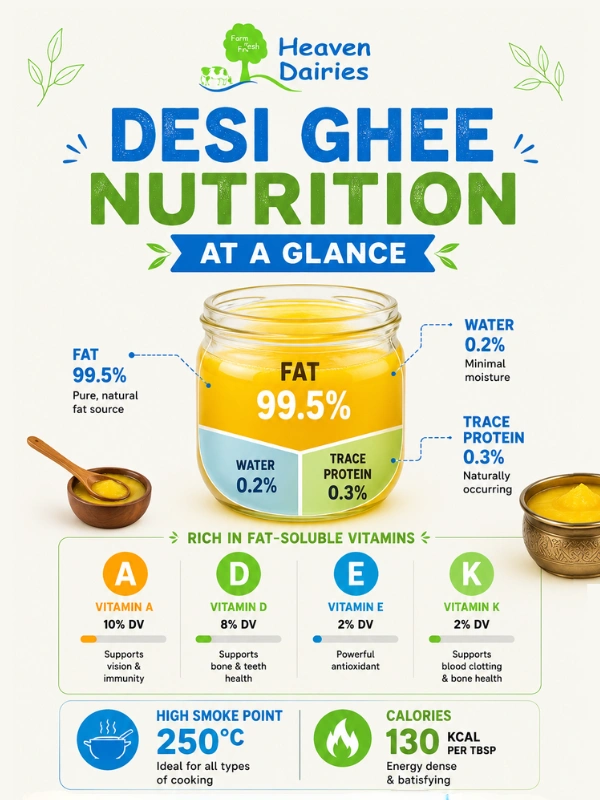
Vitamins in Desi Ghee — The Full Breakdown
Desi ghee is one of the very few cooking fats that also carry fat-soluble vitamins.
These are vitamins the body can only absorb when consumed with fat. That is why ghee, used as a cooking medium, actually helps your body absorb nutrients from vegetables and spices as well.
| Vitamin | Function | Approximate % Daily Value (per tbsp) |
| Vitamin A (Retinol) | Vision, skin health, immunity | 8–12% DV |
| Vitamin D | Calcium absorption, bone strength | 2–4% DV |
| Vitamin E | Antioxidant, skin protection | 2–3% DV |
| Vitamin K2 | Calcium regulation, heart health | Small but meaningful |
Grass-fed cows produce ghee with deeper golden colour. That colour is a signal — it reflects higher Vitamin A content. This is why pure desi ghee from grass-fed cows looks richer than factory-processed alternatives.
Vitamin K2 is particularly worth noting. It is found in very few foods. In desi ghee, it helps direct calcium into bones rather than letting it build up in arteries. This is a nutrient that urban diets in Pakistan commonly lack.
Desi Ghee Paratha Calories — What You Need to Know
Desi ghee paratha calories are one of the most searched nutrition questions in Pakistan.
Here is a clear breakdown:
| Meal | Approximate Calories |
| Plain paratha (no ghee) | 126–181 kcal |
| 1 tsp ghee on paratha | +45 kcal |
| 1 tbsp ghee used in cooking | +130 kcal |
| Full desi ghee paratha (with 1 tbsp ghee) | 250–350 kcal |
| 2 parathas with ghee (typical breakfast) | 500–700 kcal |
A desi ghee paratha made with whole wheat flour and one tablespoon of ghee contains roughly 250 to 320 calories. The exact number depends on the size of the paratha and how much ghee is used during cooking.
Is that too many calories?
Not necessarily. That depends on the rest of your meal. Pair your paratha with fresh yogurt and a boiled egg — and that becomes a complete, balanced breakfast with good protein, fat, and carbohydrates.
The problem is not desi ghee paratha calories on their own. The problem is eating 3–4 parathas without accounting for total daily intake.
The Fatty Acid Profile of Desi Ghee
Not all fats are equal. Desi ghee contains several types of fat, each with a different role in the body.
Butyric Acid (Short-Chain Fat)
Butyric acid makes up around 3–4% of desi ghee. It feeds the cells lining the gut. A healthy gut lining reduces inflammation and improves digestion. This is why desi ghee has been used in Ayurvedic medicine for digestive health for centuries.
Conjugated Linoleic Acid (CLA)
CLA is found in small amounts in desi ghee from grass-fed cows. Some research links CLA to fat metabolism support. The amounts in a daily serving of ghee are modest — it is not a weight loss supplement — but they add up over time.
Oleic Acid (Monounsaturated Fat)
Around 28% of desi ghee is oleic acid — the same fat found in olive oil. This fat is associated with heart health and anti-inflammatory effects.
Medium-Chain Fatty Acids
These are absorbed faster than long-chain fats. They are used by the body as quick energy rather than stored as body fat. This makes desi ghee a good cooking fat for active people and growing children.
Desi Ghee Health Benefits — Backed by Nutrition Science
Desi ghee is not just a cooking fat. Its nutritional profile makes it useful in several areas of health.
1. Digestive Health
Butyric acid in desi ghee supports the gut lining. A stronger gut lining means less bloating, less inflammation, and better nutrient absorption. This is especially helpful after eating heavy meals or spicy food.
Traditional Pakistani medicine has used ghee with warm milk to soothe digestive discomfort for generations. Modern nutrition science supports this mechanism through butyrate research.
2. Bone Strength
Vitamins D and K2 work together in desi ghee. Vitamin D helps the body absorb calcium. Vitamin K2 makes sure that calcium goes into bones — not into soft tissue or arteries.
For women in Pakistan, where the risk of osteoporosis increases with age, desi ghee is one of the few dietary sources of K2 available in the daily diet.
3. Immune Function
Vitamin A in desi ghee supports immune cells directly. It helps the body respond to infections and maintain healthy skin and mucous membranes — the body’s first line of defence.
Grass-fed ghee from pure, farm-fresh milk contains meaningfully more Vitamin A than commercial ghee.
4. Skin and Hair Nourishment
Vitamins A and E in desi ghee support skin elasticity. Omega-3 fatty acids improve scalp health and hair shine. Many women in Pakistan still use a small amount of ghee topically — a practice backed by its actual nutrient content.
5. Stable Cooking Fat at High Heat
Desi ghee has a smoke point of approximately 250°C. This makes it one of the safest cooking fats for frying, sautéing, and tarka. At this temperature, it does not break down into harmful compounds unlike many refined vegetable oils.
The NIH National Library of Medicine has published research reviewing both Ayurvedic and modern evidence for ghee’s health benefits, noting its anti-inflammatory and digestive properties when consumed in moderation.
Desi Ghee vs. Other Cooking Fats
A common question is how desi ghee stacks up against cooking oils commonly used in Pakistan.
| Cooking Fat | Calories (per tbsp) | Smoke Point | Saturated Fat | Vitamins |
| Desi Ghee | 130 kcal | 250°C | High (62%) | A, D, E, K |
| Butter | 102 kcal | 150°C | High (51%) | A, D, E, K (less) |
| Refined Oil | 120 kcal | 200–230°C | Low | None |
| Olive Oil | 119 kcal | 190°C | Low (14%) | Vitamin E |
| Coconut Oil | 121 kcal | 177°C | Very High (82%) | None |
Desi ghee is the only cooking fat in this list that carries all four fat-soluble vitamins and has a high enough smoke point for Pakistani cooking methods — karahi, tarka, and deep frying.
Refined oil has no vitamins and breaks down at high heat. Butter burns faster and contains lactose. Ghee is the better choice for traditional cooking when used in appropriate amounts.
How Much Desi Ghee Per Day Is Safe?
The right amount depends on your overall diet and health goals.
General guideline for healthy adults:
- 1–2 teaspoons (5–10g) per day is considered moderate and safe
- 1 tablespoon (15g) per day is reasonable for active individuals
- Beyond 2 tablespoons daily, total saturated fat intake should be monitored
People with heart disease, high LDL cholesterol, or gallbladder conditions should consult a doctor before increasing ghee intake.
For healthy children, a small amount of desi ghee on roti or in khichdi is nutritionally beneficial — particularly for brain development and energy.

Desi Ghee and Weight — Clearing Up the Confusion
A common belief in Pakistan is that desi ghee causes weight gain.
This is not accurate on its own.
Weight gain is caused by consuming more calories than the body burns — not by any single food. At 130 calories per tablespoon, desi ghee is calorie-dense. But used in moderation as a replacement for refined oils, it does not cause weight gain.
In fact, the CLA and medium-chain fatty acids in desi ghee may mildly support fat metabolism. The fat content also promotes satiety, meaning less overeating later in the day.
The issue is when ghee is added on top of an already high-calorie diet. Two parathas fried in ghee, followed by biryani cooked in oil, followed by mithai — the problem is the total, not the ghee.
Moderate, mindful use of pure desi ghee is very different from deep-frying everything in it.
How to Choose Pure Desi Ghee
Not all ghee in the market is the same. Adulteration with vegetable fat, starch, and artificial colour is common in Pakistan.
Signs of pure desi ghee:
- Colour: Deep golden-yellow. Grass-fed cows produce richer-coloured ghee.
- Texture: Slightly granular when cool. Smooth and transparent when melted.
- Aroma: Nutty, warm, and pleasant. Not chemical or rancid.
- Melt test: Pure ghee melts on the palm at body temperature.
- Heat test: Does not foam or sputter when heated slowly.
At Heaven Dairies, pure desi ghee is lab-tested, preservative-free, and made using the traditional bilona method from fresh, pasteurized milk.
You can also explore our full range of pure dairy products including fresh milk, yogurt, and khoya — all farm-to-home with the same quality standards.
Desi Ghee in Pakistani Cooking — Everyday Uses
Desi ghee is used across every type of Pakistani meal.
Common uses:
- Tarka on dal, chana, and sabzi
- Frying and cooking parathas and rotis
- Added to biryani and pulao for aroma
- Drizzled over khichdi and haleem
- Used in mithai like halwa and kheer
- Mixed with warm milk as a traditional health drink
Each use adds flavour — and also nutrition. A teaspoon of ghee on hot rice helps the body absorb the fat-soluble vitamins from the vegetables eaten alongside it. That is a practical benefit, not just tradition.
Our pasteurized fresh milk is used as the base for our ghee — so the full chain from farm to jar is clean and controlled.
If you enjoy traditional dairy-based desserts, our kulfi and khoya are made from the same farm-fresh milk. No synthetic solids. No shortcuts.
Desi Ghee for Specific Groups
Desi ghee nutrition also addresses specific Pakistani demographics. Here is what the data says:
Pregnant Women Vitamins A, D, and K2 in desi ghee support fetal bone development, skin, and nervous system growth. 1–2 teaspoons per day is safe during pregnancy. Always consult a doctor.
Children Small amounts of desi ghee on roti are beneficial for brain development (healthy fats), energy (medium-chain fatty acids), and fat-soluble vitamin absorption. It is a better cooking fat for children than refined oil.
Elderly / Menopausal Women Vitamin K2 in desi ghee may help reduce calcium loss from bones. This is particularly relevant for Pakistani women over 50 where osteoporosis is underdiagnosed.
Diabetics Desi ghee has zero carbohydrates and does not spike blood sugar. In fact, adding a teaspoon of ghee to a paratha may slow glucose absorption. Always discuss with your doctor before dietary changes.
Lactose-Intolerant Individuals Desi ghee contains negligible lactose and casein. Most people with mild dairy sensitivity can tolerate it without issue.
Final Thoughts
Desi ghee nutrition is simple once the numbers are clear.
It is a pure fat — 130 calories per tablespoon, with no carbs, no protein, and no lactose. It carries four fat-soluble vitamins that most cooking oils do not. It has a high smoke point that makes it the safest fat for Pakistani cooking methods. And when used in moderation, it supports gut health, immunity, bone strength, and skin health.
Desi ghee paratha calories matter — but they are manageable when portion sizes are reasonable and the rest of the diet is balanced.
The key is quality. Pure, traditionally made ghee delivers these benefits. Adulterated ghee does not. If you are looking for pure desi ghee delivered to your home in Lahore, Heaven Dairies has been trusted by families since 2016. Explore our farm fresh desi ghee and our full dairy product range — all farm-fresh, lab-tested, and free from preservatives.
Disclaimer: This article is for general nutritional information only. It is not a substitute for medical advice. Consult a healthcare professional before making changes to your diet, especially if you have a medical condition.
FAQs
How many calories are in 1 tablespoon of desi ghee?
One tablespoon of desi ghee (approximately 15g) contains around 130 calories. All of these calories come from fat. There are no carbohydrates or protein in desi ghee.
What are the vitamins found in desi ghee?
Desi ghee contains four fat-soluble vitamins: Vitamin A, Vitamin D, Vitamin E, and Vitamin K2. The exact amounts vary depending on the cow’s diet. Grass-fed cow ghee contains more Vitamin A and K2 than grain-fed alternatives.
How many calories does a desi ghee paratha have?
A desi ghee paratha made with whole wheat flour and one tablespoon of ghee has approximately 250 to 350 calories. The calorie count depends on the size of the paratha and the amount of ghee used in cooking.
Is desi ghee good for weight loss?
Desi ghee is calorie-dense — 130 calories per tablespoon. It is not a weight loss food on its own. However, when used to replace refined oil in moderate amounts, it does not cause weight gain. The healthy fats in ghee can reduce hunger and support satiety.
Is desi ghee safe for people with high cholesterol?
Desi ghee contains saturated fat and cholesterol. People with high LDL or cardiovascular disease should limit intake and consult a doctor. For healthy adults, 1–2 teaspoons per day in a balanced diet is generally considered safe.
What is the difference in nutrition between desi ghee and vegetable oil?
Desi ghee contains vitamins A, D, E, and K2 that refined vegetable oil does not. Ghee has a higher smoke point (250°C vs 200°C for most vegetable oils) and does not form harmful compounds at high heat as readily. Vegetable oil has no meaningful nutritional advantage over desi ghee for healthy adults.
How should desi ghee be stored?
Pure desi ghee should be kept in a sealed, dry jar. It is stable at room temperature for 6–12 months. No refrigeration is needed. Keep it away from moisture and direct sunlight to prevent rancidity.
Does cooking with desi ghee destroy its vitamins?
Desi ghee is stable at high heat up to 250°C. The fat-soluble vitamins in ghee are heat-stable at normal cooking temperatures. Nutrients are not significantly destroyed during sautéing or frying.
Is desi ghee nutritious for babies and young children?
A small amount of desi ghee added to a baby’s khichdi or dal is nutritionally beneficial after 6 months of age. It provides healthy fats for brain development and helps absorb fat-soluble vitamins from food. Always consult a pediatrician for specific amounts.
What makes Heaven Dairies desi ghee different from market brands?
Heaven Dairies desi ghee is made from fresh, pasteurized milk using the traditional bilona method. It is lab-tested, free from preservatives, and sourced from grass-fed cows. Most market brands use industrial cream-based processing that reduces nutritional quality.
2 Responses