
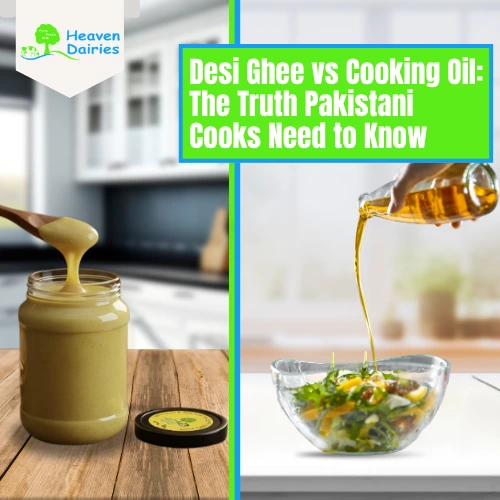
Your grandmother cooked in desi ghee. At some point, your kitchen switched to cooking oil. The advertisers said it was healthier. The price was lower. It seemed like a sensible trade.
But here is what nobody told you: the refined cooking oil in your pantry was never designed for the way Pakistani households cook. The high heat, the deep frying, the slow nihari, the tadka — these cooking methods break refined oil down into compounds your body was never meant to digest.
Desi ghee was. And the science now backs what your grandmother already knew.
This is not a nostalgia piece. This is a science-based, kitchen-practical breakdown of what happens in your pot — and why it matters for your family’s health.
What Is Desi Ghee — and What Is Refined Cooking Oil?
Before comparing them, you need to understand what each one actually is. They are not just different cooking fats. They go through completely different processes to reach your kitchen.
| Desi Ghee | Refined Cooking Oil | |
| Origin | Cow or buffalo milk cream | Extracted from seeds or plants (sunflower, soybean, canola) |
| Process | Slow-simmered, naturally clarified | Chemical solvent extraction + multi-stage refining + deodorising |
| What’s removed | Water and milk solids (natural) | Natural vitamins and nutrients (unintentional — lost in processing) |
| What remains | Pure fat, fat-soluble vitamins, butyric acid, CLA | Mostly fat — with minimal nutrition |
| Additives | None in pure ghee | Artificial antioxidants, stabilisers, often added |
| Smoke point | 250°C — very stable | 160°C–230°C depending on the oil (often lower) |
Desi ghee goes through one natural process. Refined oil goes through as many as fifteen industrial steps — including hexane solvent extraction, bleaching, and deodorising. By the end, the ‘natural’ oil in your bottle has very little left of its original nutritional character.
The Smoke Point Problem — Why This Matters in Pakistani Cooking
This is the most important factor for Pakistani kitchens. And it is the one nobody talks about plainly.
When any cooking fat reaches its smoke point, it starts to break down. It produces compounds called aldehydes and free radicals — substances linked to inflammation, cell damage, and long-term health risk. You can see this happening. The oil starts to smoke and smell.
Pakistani cooking is high-heat cooking. Karahi, deep-fried samosay, nihari with its long simmering and fat reduction, achaar tarka — all of these push your cooking fat to its limits.
| Fat / Oil | Smoke Point | Safe for Pakistani High-Heat Cooking? |
| Pure Desi Ghee | 250°C (482°F) | ✓ Yes — most stable option |
| Refined Sunflower Oil | 227°C (440°F) | ⚠ Borderline at high heat |
| Soybean Oil | 160°C (320°F) | ✗ Breaks down quickly |
| Canola Oil | 204°C (400°F) | ⚠ Moderate — not ideal for frying |
| Olive Oil (EVOO) | 190°C (375°F) | ✗ Not suited for Pakistani frying |
| Vanaspati / Dalda | Varies | ✗ Contains trans fats — avoid completely |
Pure desi ghee has the highest smoke point of any traditional cooking fat. It does not oxidise at cooking temperatures. That means the fat reaching your food is the same stable, nutritious fat that went into the pan. Refined oils at high heat are a different story.

Nutrition: What Desi Ghee Has That Refined Oil Has Lost
Pure desi ghee is a concentrated source of nutrients that refined oils simply do not carry. Here is what you get in every spoonful of authentic ghee.
| Nutrient / Compound | Found in Desi Ghee? | Found in Refined Oil? | Why It Matters |
| Vitamin A | ✓ Yes | ✗ Removed in refining | Immunity, vision, skin health |
| Vitamin D | ✓ Yes | ✗ Absent | Calcium absorption, bone health |
| Vitamin E | ✓ Yes | Trace amounts | Antioxidant — protects cells |
| Vitamin K2 | ✓ Yes | ✗ Absent | Bone and cardiovascular health |
| Butyric Acid | ✓ Yes | ✗ Not present | Feeds gut lining, reduces inflammation |
| CLA | ✓ Yes | ✗ Not present | Supports immunity and healthy metabolism |
| Omega-3 fats | ✓ Present | Varies | Anti-inflammatory, brain health |
| Trans fats | ✗ None | Present in vanaspati | Linked to heart disease — avoid |
| Note on butyric acid:Butyric acid is what makes desi ghee particularly good for your gut. Your colon cells use it as their primary fuel source. Emerging research links it to reduced gut inflammation and improved digestion — something refined oils do not provide at all. According to Harvard T.H. Chan School of Public Health, short-chain fatty acids like butyrate play a crucial role in digestive health and immunity. |
The Adulteration Reality in Pakistan — Why Your ‘Cooking Oil’ May Be Worse Than You Think
Most Pakistani households use refined vegetable oil because it appears cheaper. But the market is full of adulterated oils — blended with lower-quality fats, mixed with old or oxidised stock, or falsely labelled.
The same problem exists with ghee. The market carries plenty of fake or blended ghee — vegetable oil mixed with artificial flavouring and colour, sold as pure desi ghee.
This is why the source matters. At Heaven Dairies, our pure desi ghee comes directly from our farm’s own cream — produced from the same cows that supply our fresh milk. No vegetable oil blending. No artificial colour or fragrance. Lab-tested purity — available on request.
| How to spot fake desi ghee:Pure ghee solidifies in cool weather with a slightly grainy texture and golden colour. It melts on your palm within seconds. It has a clean, nutty aroma when heated. If your ghee stays liquid in winter, smells chemical or waxy, or has a bright artificial yellow colour — it is not pure.See our full guide:Best Desi Ghee Brand in Pakistan: How to Identify Real Desi Ghee |
Desi Ghee in the Pakistani Kitchen — Practical Cooking Guide
You do not need to cook everything in ghee. You need to cook the right things in ghee. Here is a practical guide for the Pakistani kitchen.
| Cooking Method | Best Fat to Use | Why |
| Deep frying (samosay, pakore, poori) | Desi ghee or stable refined oil | Ghee’s smoke point handles sustained high heat without oxidising |
| Karahi and bhunai | Desi ghee | Adds flavour depth and handles the repeated high-heat stirring |
| Tadka / tarka | Desi ghee | The aroma released by ghee in tadka is the point — oil cannot replicate it |
| Slow-cooked curries (nihari, paya) | Desi ghee | Long cooking time at moderate heat — ghee remains stable and enriches the dish |
| Baking (kheer, halwa, mithai) | Desi ghee | Essential for authentic flavour and texture in Pakistani sweets |
| Light sautéing (vegetables) | Either | Refined oil is acceptable at low-moderate heat for neutral-flavour dishes |
| Salad dressings | Olive oil | Ghee is not suitable cold — reserve it for heat-based cooking |
A common question is whether using desi ghee increases cholesterol. The current nutritional science is clear: saturated fats from whole, natural sources like ghee — consumed in moderate amounts — do not cause the same harm as trans fats from vanaspati or oxidised fats from overheated refined oils. The bigger risk is the aldehydes your body absorbs every time cheap oil burns in a hot pan.

How Much Desi Ghee Is Safe to Use Daily?
Ghee is calorie-dense — one tablespoon contains around 120 calories. This is not a reason to avoid it. It is a reason to use it with awareness.
• Healthy adults: 1–2 tablespoons per day is a reasonable amount for cooking
• Children: A small amount daily supports brain development and fat-soluble vitamin absorption
• Elderly: Ghee supports joint lubrication and bone health — moderate use is beneficial
• People with heart conditions: Consult a doctor, but moderate amounts of pure ghee are very different from vanaspati or trans-fat-heavy oils
The danger is not ghee. The danger is overusing any fat — or using the wrong fat at the wrong temperature and producing harmful compounds. One teaspoon of ghee in your sabzi does your family far less harm than 200ml of sunflower oil heated past its smoke point in a karahi.
The Switch Your Kitchen Has Been Waiting to Make
Refined cooking oil won the Pakistani kitchen through marketing, not merit. Desi ghee lost its place not because it was unhealthy — but because it was more expensive and advertisers had a cheaper product to sell.
The science has caught up. Pakistani cooking methods — high heat, deep frying, slow cooking, aromatic tadka — suit desi ghee far better than any refined oil. The nutrition is richer. The stability is higher. The flavour is incomparable.
The one condition is purity. Adulterated ghee defeats the entire purpose. That is why choosing a verified, farm-sourced ghee matters as much as choosing ghee over oil. Our pure desi ghee in Lahore comes from our farm’s own cream, lab-tested and delivered fresh. And if you want to understand what to look for before you buy any ghee, our guide on identifying the best desi ghee brand in Pakistan will help you make the right call.
Frequently Asked Questions
Q: Is desi ghee healthier than cooking oil for Pakistani cooking?
A: Yes — for Pakistani cooking methods specifically. Desi ghee has a smoke point of 250°C, making it stable under the high heat of karahi, deep frying, and tadka. Most refined oils break down at high temperatures and produce harmful aldehydes. Ghee also contains fat-soluble vitamins, butyric acid, and CLA — nutrients refined oils do not have.
Q: Does desi ghee increase cholesterol?
A: Pure desi ghee contains saturated fats, but current nutritional research shows that natural saturated fats from dairy sources — used in moderate amounts — behave differently from trans fats in vanaspati. Moderate ghee use (1–2 tablespoons daily) is not linked to harmful cholesterol increases in healthy individuals. People with existing heart conditions should consult their doctor.
Q: Can I replace all cooking oil with desi ghee?
A: You can replace it for high-heat cooking, frying, tadka, and Pakistani curries. For cold applications like salad dressings, olive oil or other liquid oils are more practical. Ghee solidifies at room temperature and is not suited for cold use.
Q: Why does desi ghee smell different from cooking oil when heated?
A: Desi ghee releases a rich, nutty aroma when heated because of the natural milk solids and fat compounds it retains. This is actually the Maillard reaction from the clarification process — the same chemistry that makes browned butter smell good. Refined oils are deodorised during processing, which is why they have a neutral smell — but also why they lack flavour.
Q: How much desi ghee should I use per day?
A: For healthy adults, 1–2 tablespoons per day used in cooking is a reasonable amount. This is enough to gain the nutritional benefits without excessive caloric intake. Children and elderly family members benefit from moderate daily ghee in their food — it supports brain development, joint health, and vitamin absorption.
Q: What is the difference between desi ghee and vanaspati (Dalda)?
A: They are completely different. Desi ghee is pure clarified butter from milk — a natural fat with vitamins and butyric acid. Vanaspati is hydrogenated vegetable oil — an artificial fat that contains trans fats, which are directly linked to heart disease and inflammation. Never substitute one for the other.
Q: Where can I get pure desi ghee in Lahore?
A: Heaven Dairies supplies farm-produced, lab-tested pure desi ghee in Lahore. It is made from the cream of our own farm’s cows — with no vegetable oil blending, no artificial colour, and no added fragrance. Order via our website or WhatsApp for home delivery.